AsOneWishes.com
Showing posts with label Exercise Injuries. Show all posts

Monday, 25 July 2011

Top 10 Tips to Lose Weight Injury Free

It is possible for you to lose weight relatively injury free. But, you can also wreck your body with injuries while training to lose weight. You won't hear this information in a weight loss commercial because they're selling you a product.


So, here are my Top 10 Tips to Lose Weight Injury Free:

1. Warmup properly and do exercises with correct technique. This is crucial every workout! Walking for 2 minutes or talking to your friend is not a good warm-up.

A good dynamic warm-up prepares your body best for intense workouts. A sample dynamic warm-up could be a 5-10 minute jog, prisoner squats, lunges, etc. Static stretches would be done after your workout.

2. Don't underestimate the benefits of sports massages. The benefits include improved flexibility, tension release, relieving of swelling, alleviation of fatigue and prevention of injuries.

Along the same lines, self myofascial release with foam rolls (SMFR) is a type of self massage that you can do every day and prevent various muscle injuries, strains and tears.

3. Protect your feet. Its amazing how many injuries can be avoided by wearing quality footwear (interpreted: don't wear cheap athletic shoes). If you have flat feet or high arches you definitely need the right footwear and/or inserts.

4. Avoid various tendon, ligament and muscle injuries (pain, swelling) caused by over-training and wear and tear. Rest and recovery is important. R.I.C.E.R. (REST, ICE, COMPRESSION, ELEVATION, REFERRAL FOR MEDICAL ASSISTANCE) should be followed immediately after a muscle or tendon injury.

5. Lessen the risk of a knee anterior cruciate ligament (ACL) injury. It is the most common injury affecting the knee joint.

Do this by having adequate hamstring strength and practicing proper landing, jumping, stopping and cutting techniques.

6. Strengthen and stretch your shoulder muscles to avoid rotator cuff, shoulder and elbow injuries.

7. Strengthen and stabilize your core to prevent injuries such as low back pain, oblique strains/pulls, neck pain, ruptured disks and various other muscle and ligament strains.

8. Avoid shin splints by not over-training and wearing quality footwear.

Also, exercising on hard or uneven surfaces or excessive uphill or downhill running can cause shin splints. If you over-pronate (foot and ankle rolls excessively inward when running), you are at risk for shin splints.

9. Lessen the risk of a torn or injured Achilles tendon (the largest tendon in the body). It takes a full year to recover from a torn Achilles tendon. Stretch and stabilize the tendon with one-legged exercises, calf/peroneal stretches and Achilles tendon stretch.

10. You don't want Plantar Fasciitis (the long, flat ligament on the bottom of your foot stretches too much, small tears develop and the ligament inflames (ouch!!)!

Plantar Fasciitis usually develops over time so take steps to correct the problem when it first occurs by keeping your foot and ankle area flexible. And, take time to recover from heel and foot pain. Also, don't wear (you guessed it!) cheap running shoes! Excessive running on steep hills or inclines can also cause Plantar Fasciitis.

Don't wreck your body with injuries trying to lose weight!

Train hard and smart!

Download your FREE 10-Minute Fat Burning Workouts now!

"Exercise is not my life.....exercise makes my life better!"

Check out my other great blogs:

Her Fitness Hut Blog Her Fitness Hut is featured on EmpowHER, a great health issues website for women! Her Fitness Hut has also been named in the Top 50 Personal Training Blogs by Physical Therapy Assistant Schools!

Sports Fitness Hut Blog has been recognized by Stanford University Wellsphere as the #1 Sports Fitness Blog and NursingDegree.net as one of the Best 100 Health and Nutrition Blogs for Athletes! The blog has also been named as one of the "50 Best Sports Medicine Blogs by Masters In Healthcare! It is an honor to be recognized by those in the health and academic fields! Afterall, health is number one for everybody---including athletes!

Wednesday, 20 July 2011

How to Prevent Exercise Injuries

The best way to prevent exercise injuries is to prepare your body for training. Or, don't just jump into training "out of shape."


"Training to train" or preconditioning will prevent or minimize exercise injuries. Muscle areas such as the hamstrings need preconditioning because the hamstrings are prone to injury. Preconditioning can be done all year to supplement your main training program.

Here are 3 key ways to prevent exercise injuries:

1. Eccentric contraction training (force reduction) of your muscles can significantly reduce your injury risks.

These exercises help build eccentric contraction strength:

--Running downhill.

--Depth jumps (emphasize the landing and hold only).

--Eccentric muscle contraction weight training (i.e., the lowering phase of a lift). For example, you would lift the weight on a hamstring curl for one count and lower the weight for 3-4 counts.

Injury risks like torn anterior cruciate knee ligaments, achilles tendon strains/tears and hamstring pulls can be lessened with proper training.

2. Improve your muscular balance. For example, your quadricep muscles should not be significantly stronger than your hamstring muscles. Your frontside should not be significantly stronger than your backside. And, your left side should not be significantly stronger than your right side.

When you are strength training, keep this important principle in mind. Get your muscles balanced early in the training progressions. One-legged and one-armed exercises help you to achieve and maintain muscular balance.

3. Improve your flexibility and range of motion. Do strength exercises (including core) with a full range of motion unless you are in rehabilitation. Rehab exercises are done to restore your full range of motion.

It is a misconception that strength training makes your body's muscles "tight and inflexible." This won't happen if you consistently improve your joints' range of motion (dynamic flexibility) and perform exercises with full range of motion. You CAN be strong and flexible!

Work hard and safely!

Download your FREE 10-Minute Fat Burning Workouts now!

"Exercise is not my life.....exercise makes my life better!"

Check out my other great blogs:

Her Fitness Hut Blog Her Fitness Hut is featured on EmpowHER, a great health issues website for women! Her Fitness Hut has also been named in the Top 50 Personal Training Blogs by Physical Therapy Assistant Schools!

Sports Fitness Hut Blog has been recognized by Stanford University Wellsphere as the #1 Sports Fitness Blog and NursingDegree.net as one of the Best 100 Health and Nutrition Blogs for Athletes! The blog has also been named as one of the "50 Best Sports Medicine Blogs by Masters In Healthcare! It is an honor to be recognized by those in the health and academic fields! Afterall, health is number one for everybody---including athletes!

Saturday, 18 December 2010

Prevent Butt, Hip And Thigh Injuries

You can prevent painful butt, hip and thigh injuries by conditioning your muscles to prepare for workouts. For example, tight hip flexors lead to some very painful injuries.


Your athletic movements during workouts are dominated by the hips, glutes, quadriceps and hamstrings. All of these muscle regions need to work properly or you will not go very long without injury.

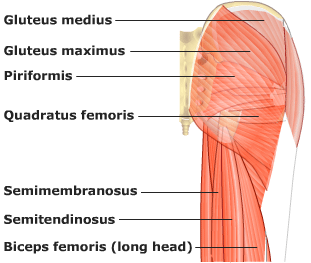
The gluteus maximus is the largest muscle of the buttocks. The anatomy of the gluteal region (gluteus maximus, gluteus medius, gluteus minimus) is shown below:


The glutes don't fire properly when the hip flexors (psoas, iliacus, tensor fascia latae, etc.) are overactive or tight. This can happen due to poor flexibility or prolonged sitting. When the hip flexors don't work properly, its antagonist (mainly the gluteus maximus) becomes weak.

This is known as reciprocal inhibition (when muscles on one side of a joint become tight or overactive, it shuts down the muscles on the other side of the joint). When a prime mover (such as the gluteus maximus) becomes weak, other muscles (synergists) take over the function that the prime mover should be doing.

Some injuries that occur because of inactive glutes are hamstring injuries, piriformis syndrome, knee ACL tears and low back injuries. Okay, enough of the technical stuff!

So, what do you need to do to fire up your glutes?! First, you need to understand why your glutes are not firing properly. They are probably not receiving the neural drive from your central nervous system.

So, it is probably not an issue of strength. Their are some exercises you can do to correct this problem. First, you need to lengthen tight muscles. The stretches are listed as follows (use self myofascial release with foam roller before doing these stretches):

1. Hip Flexor Stretch
2. Quadriceps Stretch
3. Bodyweight Lateral Lunges (for adductors)

Then, you need to activate (fire up) your glutes with these exercises:

1. Glute Bridge
2. Opposite Leg Opposite Arm Raise
3. Glute Kickbacks

Lastly, exercise the fired up glutes with these exercises:

1. Bodyweight squats
2. Lateral tube walks (pictured above)
3. Walking Lunges

Get your rear in gear and take care of your body!

If you need to know how to lose weight the right way, get My Fitness Hut's 7-Day Weight Loss And Fat Loss e-Course! The e-Course is FREE!

"Exercise is not my life.....exercise makes my life better!"

Check out my other great blogs:

Her Fitness Hut Blog Her Fitness Hut is featured on EmpowHER, a great health issues website for women! Her Fitness Hut has also been named in the Top 50 Personal Training Blogs by Physical Therapy Assistant Schools!

Sports Fitness Hut Blog has been recognized by Stanford University Wellsphere as the #1 Sports Fitness Blog and NursingDegree.net as one of the Best 100 Health and Nutrition Blogs for Athletes! The blog has also been named as one of the "50 Best Sports Medicine Blogs by Masters In Healthcare! It is an honor to be recognized by those in the health and academic fields! Afterall, health is number one for everybody---including athletes!
Sunday, 5 September 2010

Top 10 Runners' Foot Injury Prevention List

If you are a dedicated runner, you are at risk for more foot injuries than the average exerciser. Prevention of injuries is always best. If you train to run races such as 5Ks, 10Ks, marathons or triathlons, your risk for foot injuries increase even more. I have seen more than one friend over-training for these events and literally "running themselves into the ground."


Repetitive stress injuries like plantar fasciitis, runner's knee and Achilles tendinitis are just a few of the injuries you should try and prevent. Its just common sense for runners to take care of their feet. Many of you don't adequately care for your feet.

Did you know that every stride you take while running applies a force of 3-4 times your body weight across your knees, ankles and feet? Enough said!

New York City podiatrist, Dr. Oliver Zong, is one of the premier cosmetic foot surgeons in the country. He serves as the Director of Surgery at NYC FootCare and is on the Board of Directors at Gramercy Park Surgery Center. Dr. Zong offers foot related advice and tips to runners training for and participating in the New York City Marathon.

So, here is Dr. Zong's Top 10 injury prevention list for runners:

1. Stretching. Stretching primes the body for the strenuous activity. Stretch before and after running. Concentrate on the calves, hamstrings, quads and feet.

2. Shoes. Invest in a good pair of running shoes. They provide specific impact support that running demands. If your feet sweat heavily during running, try putting talcum powder in your shoes to keep feet dry.

3. Orthotics. If you have arch or heel pain, you may be a perfect candidate for orthotics. Visit a podiatrist to inquire about purchasing orthotics for your shoes.

4. Socks. Cotton socks absorb moisture. For a long run like a marathon, your feet may require a synthetic sock (containing acrylic), which helps alleviate moisture from your skin. Make sure that the seams of your socks are not in an area of pressure, which can lead to a lot of pain. If you cannot find a comfortable location for the seams, try turning socks inside out.

5. Anti-Inflammatory Medications. Do not pop Advil or Aleve before a race to prevent aches that may arise during the race. Save this treatment for the day after the race. Taking anti-inflammatory medications will mask any pain that is felt during the race and can lead to more serious injury. Pain is a valuable feedback mechanism that you need to pay attention to during a long run.

6. Groom Toenails. Make sure your toenails are not long before a race. They should not extend past the tip of your toe and should be shaped in a straight cut. If you do not properly groom your toenails before a marathon, you run the risk of developing an ingrown nail or even a fungal nail.

7. Toes. If you have a tendency to develop corns and callouses on the tips of your toes, try adding padding in your sneakers underneath your toes. If your toes or toenails turn black, you may have developed subungual hematoma (bleeding under the nails). This may cause nails to fall off. Keep the area clean and dry to prevent infection and seek treatment from your podiatrist.

8. Blisters. Blisters are the results of excessive friction between shoes and feet. Take preventative steps by making sure shoes fit properly and are laced up so that they are form fitting to your feet. If you are prone to blisters, apply Vaseline to problem areas prior to your run or try padded "blister proof" socks like those made by Thorlo. Additionally, applying moleskin to problem areas also prevents blisters from forming.

9. Visit Your Podiatrist. Dr. Zong's patients who run in the New York City Marathon make appointments the entire week before the race to get rid of corns, callouses, get moleskin, have their orthodics padded, and in some cases receive cortisone injections for their heel spurs (plantar fasciitis).

10. Finish Line. When the race is complete Dr. Zong says practice RICE:

a. Rest your feet.
b. Ice helps keep inflammation and swelling down.
c. Compression with ACE wraps will also reduce swelling.
d. Elevation will help your feet rest up for the next big run.

Dr. Zong is credited with coining the terms, "Foot Makeover", "Foot Facelift", "The Toe Tuck", and "High Heel Feet".

Read my article series on lower leg running injuries.

"Exercise is not my life.....exercise makes my life better!"

Check out my other great blogs:

Her Fitness Hut Blog Her Fitness Hut is featured on EmpowHER, a great health issues website for women! Her Fitness Hut has also been named in the Top 50 Personal Training Blogs by Physical Therapy Assistant Schools!

Sports Fitness Hut Blog has been recognized by Stanford University Wellsphere as the #1 Sports Fitness Blog and NursingDegree.net as one of the Best 100 Health and Nutrition Blogs for Athletes! The blog has also been named as one of the "50 Best Sports Medicine Blogs by Masters In Healthcare! It is an honor to be recognized by those in the health and academic fields! Afterall, health is number one for everybody---including athletes!

Wednesday, 25 August 2010

Step Ups Strengthen Gluteus Medius

The step up is one of the best exercises to strengthen your gluteus medius and tone your leg muscles. Weakness in the gluteus medius can result in knee and back injuries. Weakness in the gluteus medius also contributes to instability when you walk, run and jump.


Step ups will also improve your dynamic balance. Its not that easy to balance all your weight on one leg (with good form) while stepping up onto a platform.

1. Face a bench or platform (knee high) and put your right foot on the bench. Your knee should be bent 90 degrees. Don't do this exercise with dumbbells until you have mastered the bodyweight version.

2. As you lift your body on your right leg, keep your body erect (don't bend over) and look straight ahead. Balance on your leg for 1-2 seconds and descend. Don't let your left foot touch the platform.

3. Do all required repetitions on the right leg and switch to left leg.

You may have to start with a platform lower than knee-high. Your hamstrings and butt will be worked more with a higher platform.

Exercises like the step up are important because it uses the same pathways that it takes to walk or run. Plus, one leg cannot compensate for weakness in the other leg. If your left leg is weaker, it will be forced to "catch up" to the right leg. Muscular balance is important to avoid injuries.

Step up to your next workout!

If you need to know how to lose weight the right way, get My Fitness Hut's 7-Day Weight Loss And Fat Loss e-Course! The e-Course is FREE!

"Exercise is not my life.....exercise makes my life better!"

Check out my other great blogs:

Her Fitness Hut Blog Her Fitness Hut is featured on EmpowHER, a great health issues website for women! Her Fitness Hut has also been named in the Top 50 Personal Training Blogs by Physical Therapy Assistant Schools!

Sports Fitness Hut Blog has been recognized by Stanford University Wellsphere as the #1 Sports Fitness Blog and NursingDegree.net as one of the Best 100 Health and Nutrition Blogs for Athletes! The blog has also been named as one of the "50 Best Sports Medicine Blogs by Masters In Healthcare! It is an honor to be recognized by those in the health and academic fields! Afterall, health is number one for everybody---including athletes!

ping blog

Step 1
Blog URL:


Blog Title (optional):


Blog RSS Feed (optional):


I agree with terms of service.

Step 2
Copy the following code and put it on your blog/site to help our blog ping tool track your submission (Need help?):
;

 
Design by Free WordPress Themes | Bloggerized by Lasantha - Premium Blogger Themes | Best Buy Coupons